

Kimi Antonelli ended Formula 1’s first day at the Madring on top, lapping the new Madrid circuit in 1:33.662 to head second practice for the Spanish Grand Prix — but the session’s defining moment belonged to Arvid Lindblad, who put his Racing Bulls into the TecPro barriers at Turn 13 to bring out the venue’s first red flag.
The 18-year-old Briton, the only rookie on the 2026 grid, was running fourth and just 0.228s off Antonelli’s benchmark when he lost the rear of the car at the left-hander around 35 minutes in, with 25 minutes left on the clock. The rear struck the barrier first, the front followed, and the session was stopped while marshals cleared the debris. Lindblad climbed out unhurt and was immediately contrite on team radio: “Yeah, I’m really sorry. I lost it super early.”
Antonelli’s Mercedes led Charles Leclerc’s Ferrari by 0.113s, with Lewis Hamilton third at 0.149s. Lindblad’s 1:33.890 still stood as the fourth-quickest time of the afternoon when the flag fell — ahead of George Russell, Max Verstappen and Oscar Piastri.
A rookie’s best lap and worst moment, ten minutes apart
Lindblad had been the story of the session before he was the story of the session. Seventh in a clean, incident-free FP1 won by Russell, he found close to 1.2s in the second hour and was splitting the two front-running teams on a circuit nobody had driven before Friday morning. For a driver in a Racing Bulls, on a track with concrete walls where the run-off runs out, that was a statement.
It was also the kind of lap that invites the next one. Turn 13 is a medium-speed left that loads the rear tyre at exactly the point the soft compound has started to give up, and Lindblad found the limit a fraction beyond it. The damage looked substantial enough to leave his mechanics with a long night before FP3.
Context matters here. Lindblad scored on debut in Melbourne, finishing eighth to become the third-youngest points-scoring debutant in F1 history, and has spent the season being measured against Yuki Tsunoda in the sister car. On Friday in Madrid he beat him by 0.868s. The crash costs his team money and sleep; it does not undo what the timing screens showed.
Mercedes carry Monza form into Madrid
Mercedes topped both sessions, Russell in the first, Antonelli in the second, and the gap back to Verstappen in sixth — 0.401s — suggests the pattern of the past month is holding. Antonelli arrives in Spain having won at Monza from 19th on the grid, a result that pushed his championship lead to 66 points over Russell. Hamilton is third, 76 adrift.
Ferrari’s Friday was the more encouraging surprise. Leclerc and Hamilton locked out second and third in FP2 within four hundredths of each other, on a layout whose long straights and heavy braking zones were expected to punish them. The one-lap picture is genuine; the race picture is not, because the red flag arrived before most of the field had completed representative soft-tyre runs.
McLaren left Madrid on Friday with almost nothing. Lando Norris, the reigning world champion, managed two laps in FP2 before a transmission failure stopped him. “The gearbox is still in false neutral. It seems really bad,” he reported. He set no time and ended the session 22nd, with a gearbox change and a night of lost data ahead of him. Piastri, seventh, was 0.538s off.
The Madring passes its first test — just
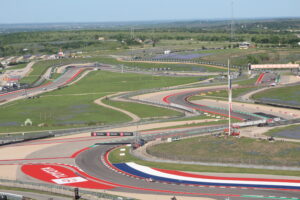
The 5.416km circuit around the IFEMA exhibition centre is a hybrid of public roads and private land, closer in concept to Miami than to Barcelona, with 22 corners, two tunnel sections, real elevation change and La Monumental — a 550-metre banked corner shaped after a Spanish bullring. It brings grand prix racing back to Madrid for the first time since Jarama staged the 1981 Spanish Grand Prix, the race Gilles Villeneuve won in the closing laps in what many still rate his finest drive.
Friday delivered on the concerns and the promise at once. FP1 ran without incident despite the narrow margins. FP2 produced exactly what the walls threatened: one mistake, one barrier, one session effectively ended for everyone. Drivers described the surface and the constant lateral loading as punishing on soft-tyre temperature, which is a qualifying problem before it is a race problem.
That makes FP3 unusually valuable. Teams need long-run data they did not get, Ferrari need to know whether their single-lap pace survives contact with tyre degradation, and McLaren simply need laps. For Lindblad, the requirement is narrower and harder: repeat the pace, skip the crash.

Sports journalist and editor at SportsPortal.net. Covers cricket, football, Formula 1, tennis, and basketball with a focus on how global sports connect with Pakistani audiences. Follows the PSL, Pakistan national cricket team, Premier League, and major international tournaments. Has reported on sports for digital audiences since 2021.
1069 articles published