

In early 2005, two doctors from Great Ormond Street Hospital walked into Ferrari’s factory at Maranello and played the team’s technical director a video. It was not footage of a race. It showed a critically ill child being moved from an operating theatre to paediatric intensive care — ventilator, drips, monitors, infusion lines, and a verbal handover of information between the surgical and ICU teams.
Nigel Stepney, who had spent his career shaving tenths of a second off pit stops, was unimpressed. The hospital’s process looked improvised, informal and cluttered with people talking over one another. Two years later, the protocol those conversations produced was published in the journal Pediatric Anesthesia. Technical errors during handover fell from a mean of 5.42 per patient to 3.15. Information omissions fell from 2.09 to 1.07. The handover got shorter, not longer: 10.8 minutes down to 9.4.
A Sunday race and a seven-page protocol
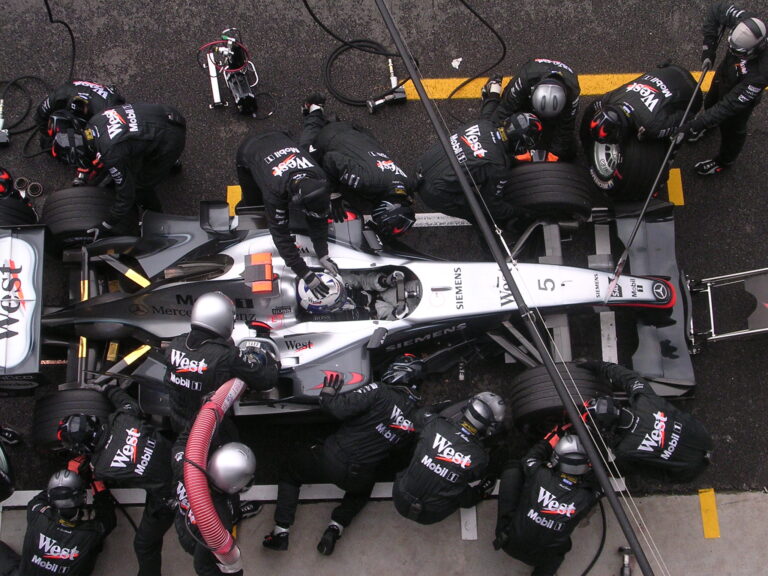
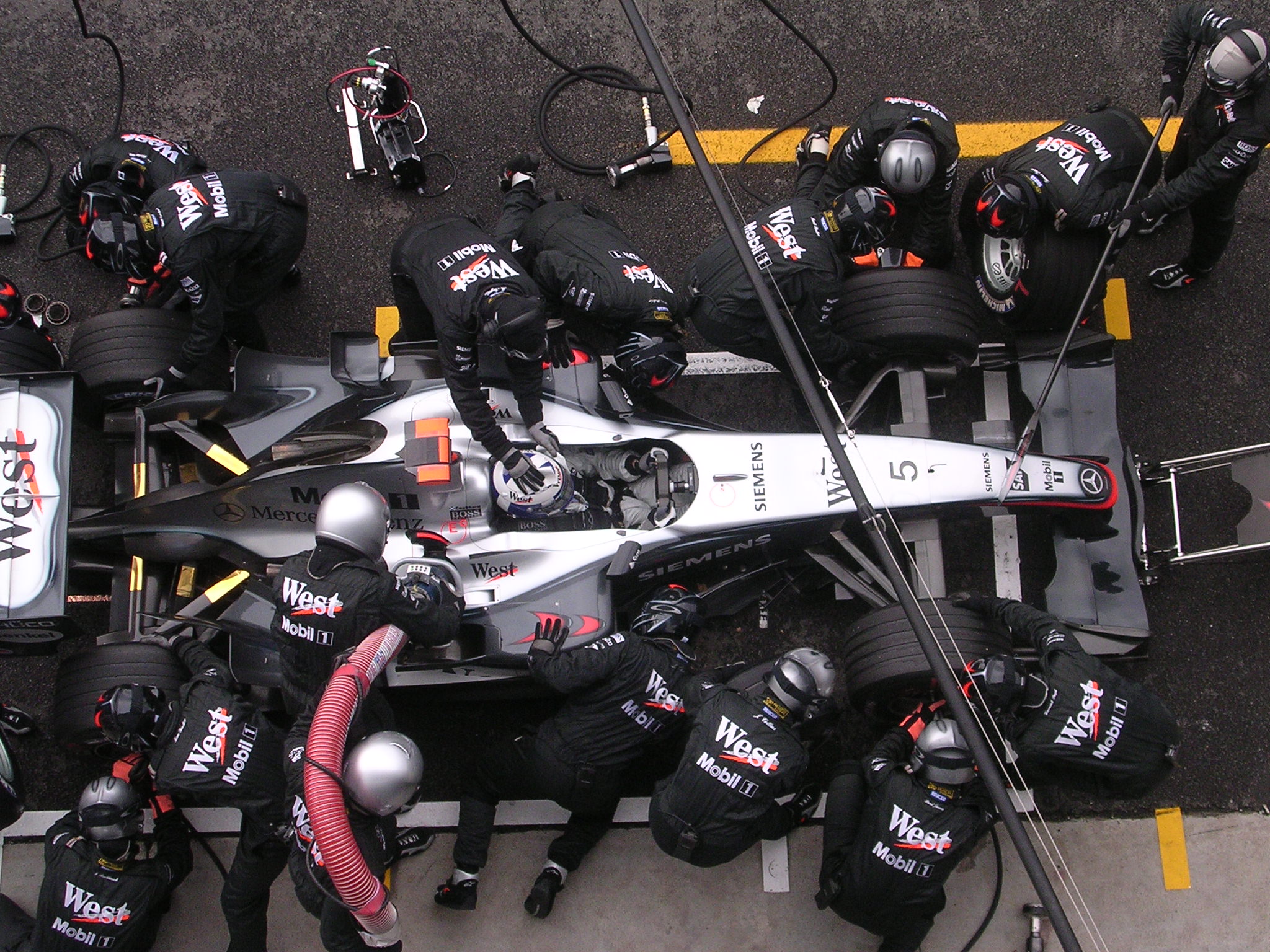
The idea began with a television. Allan Goldman, a paediatric intensive care specialist, and Martin Elliott, a cardiac surgeon, were watching a Grand Prix after a long operating day when the pit stops caught their attention — roughly 20 people, a stationary car, fuel and four tyres changed in under seven seconds, nobody speaking unnecessarily, everybody owning exactly one job.
The comparison was not sentimental. Great Ormond Street’s handover of infants after open-heart surgery was one of the riskiest moments in the entire pathway: a sedated, unstable patient, dozens of pieces of equipment to transfer, and a complete change of clinical team. The failures clinicians reported were not failures of medical knowledge. They were role confusion, interruptions, equipment arriving in the wrong order, and information that simply never got said out loud.
At Maranello, Stepney walked them through how a Ferrari crew is built: one leader who does not touch the car, fixed task allocation, a rehearsed sequence, silence as a default, and a debrief after every stop. Back in London, Goldman, Elliott and the human factors researcher Ken Catchpole wrote a seven-page document specifying every step of the handover — who moves what, in what order, who speaks and when. Two aviation training captains then observed handovers under the new system and suggested further refinements, importing the aviation habit of the structured, read-aloud checklist.
What the data actually showed
The 2007 study is the reason this story is more than an anecdote. Before the new protocol, nine of 23 patients had more than one error in both technical handover and information handover. Afterwards, that figure was three of 27 — a drop from 39% to 11.5%. Technical errors were cut by 42%, information omissions by 49%.
Three details made the result credible to sceptics. First, the gains came from process, not new equipment or extra staff. Second, the handover became faster, puncturing the assumption that safety procedures inevitably slow clinicians down. Third, the intervention was explicitly borrowed from two industries — motorsport and aviation — that had already solved the problem of coordinating expert teams under time pressure, rather than invented from scratch inside medicine.
Elliott’s framing has stuck with the field ever since: the precious parcel on the trolley is the same as the precious parcel in the car, and every step has to be right.
From the pit wall to the ward
The Great Ormond Street work landed just as hospital safety culture was changing. The WHO Surgical Safety Checklist followed in 2008, and structured handover bundles are now routine in cardiac and neonatal units worldwide, in hospitals that have never heard of Stepney. Formula 1’s contribution was not the checklist itself but the proof that a chaotic, high-stakes transfer could be choreographed.
The traffic has continued in both directions:
- Williams worked with the University Hospital of Wales on neonatal resuscitation, applying pit-crew principles to how equipment is laid out and reached for.
- Williams engineers and Advanced Healthcare Technology developed the Babypod, a carbon-fibre infant transport carrier built to survive a 20G impact.
- Cornwall’s air ambulance crew trained at Silverstone and cut their take-off time from five minutes to three and a half.
Motorsport has moved on too. A stop that took seven seconds in the early 2000s now takes around two, with the record standing at 1.80 seconds, set by Red Bull for Max Verstappen at the 2019 Brazilian Grand Prix. That relentless compression is the point. Pit crews improved because they filmed themselves, debriefed every attempt and treated a wasted half-second as a defect.
The unfinished work in hospitals is exactly that discipline. Protocols are written and then drift; staff rotate; checklists become box-ticking. The teams that have sustained the gains are the ones that kept the other half of the Ferrari model — rehearse it, record it, review it, and never assume last week’s handover was good enough.

Sports journalist and editor at SportsPortal.net. Covers cricket, football, Formula 1, tennis, and basketball with a focus on how global sports connect with Pakistani audiences. Follows the PSL, Pakistan national cricket team, Premier League, and major international tournaments. Has reported on sports for digital audiences since 2021.
1007 articles published