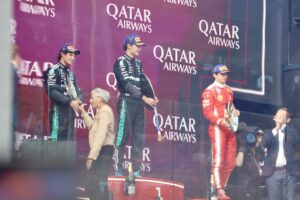




Max Verstappen’s decision to enter the Nurburgring 24 Hours last weekend — racing a Ferrari 296 GT3 under the pseudonym “Franz Hermann” before retiring with a wheel-bearing failure after 11 hours — has reopened a question F1 fans have asked for decades. Why don’t more grand prix drivers moonlight in other categories? Ahead of Sunday’s Canadian Grand Prix at the Circuit Gilles Villeneuve, where Verstappen sits 31 points behind championship leader Oscar Piastri, BBC Sport’s Andrew Benson tackles the latest reader questions on contracts, calendars and the commercial machinery that keeps the paddock locked down.
Why can’t drivers race elsewhere when Verstappen can?
The short answer is contracts. Verstappen’s Red Bull deal, signed through 2028, contains a specific carve-out negotiated by his manager Raymond Vermeulen that permits GT racing outside the F1 calendar. It is a near-unique clause. Lewis Hamilton’s Ferrari contract, by contrast, prohibits competition in any FIA-sanctioned series without written approval. Lando Norris and Charles Leclerc operate under similar restrictions at McLaren and Ferrari respectively.
Teams cite three concerns. The first is insurance: a top-line driver’s market value runs into the hundreds of millions over a contract term, and underwriters charge punitive premiums for any activity classed as motorsport outside F1. The second is calendar congestion. With 24 grands prix, six sprint weekends and roughly 35 contracted promotional days, drivers have perhaps 40 free days a year — most of which sponsors and team principals want for simulator work. The third is reputational. A heavy crash at Spa or the Nordschleife in a customer GT3 car is a public-relations problem no team wants to manage mid-season.
Verstappen’s leverage is unusual. He is a three-time world champion who has publicly threatened retirement, and Red Bull has accepted that allowing his side projects — including his sim-racing team Team Redline — is part of the cost of keeping him. Few others have that bargaining position.
Can Mercedes and Ferrari close on McLaren in Montreal?
The gap is real but not insurmountable. McLaren have won six of eight rounds in 2026, with Piastri taking four and Norris two, and the team leads the constructors’ standings by 87 points. But Montreal historically rewards traction and braking stability over the high-speed aerodynamic efficiency that has defined McLaren’s MCL40. The chicane onto the start-finish straight, the heavy braking zones at Turns 10 and 13, and the proximity of the walls all flatter cars that can put power down cleanly.
George Russell finished second in Montreal last year and Mercedes have brought a revised floor for this weekend, focused on low-speed downforce. Ferrari’s SF-26 has been quicker than the McLaren in race trim at two of the last three rounds, and Leclerc has a strong Canadian record — pole in 2022 and 2024, victory in 2024. Expect a closer fight than the championship table suggests. A wet qualifying session, which the forecast is currently giving a 60 percent probability of, would scramble the order further.
What does Antonelli’s run of form mean for Mercedes?
Kimi Antonelli’s three consecutive podiums — Imola, Monaco and Barcelona — have changed the conversation around Mercedes. The 19-year-old Italian, who replaced Hamilton at the start of the season, has out-qualified Russell in four of the last five rounds and now sits fifth in the drivers’ championship with 94 points. That is the strongest start by a Mercedes rookie since Nico Rosberg’s Williams debut in 2006.
The significance extends beyond raw results. Toto Wolff invested heavily in Antonelli’s junior career through the Mercedes development programme, signing him at 11 and funding his progression through karting, Italian F4 and Formula 2. A return on that investment validates a long-term recruitment model the rest of the grid has been slower to copy. It also gives Mercedes a settled driver pairing for the 2026 regulation cycle, which began this season with the switch to active aerodynamics and 50 percent electrical power.
The questions now are about ceiling. Antonelli has yet to win a grand prix and has been comfortably beaten by Russell on pure pace in qualifying. But the trajectory is the steepest in the field, and a podium in Montreal — where he tested an older Mercedes for two days last month under the team’s young-driver allowance — would extend a run that already looks like the rookie story of the decade.

Sports journalist and editor at SportsPortal.net. Covers cricket, football, Formula 1, tennis, and basketball with a focus on how global sports connect with Pakistani audiences. Follows the PSL, Pakistan national cricket team, Premier League, and major international tournaments. Has reported on sports for digital audiences since 2021.
932 articles published