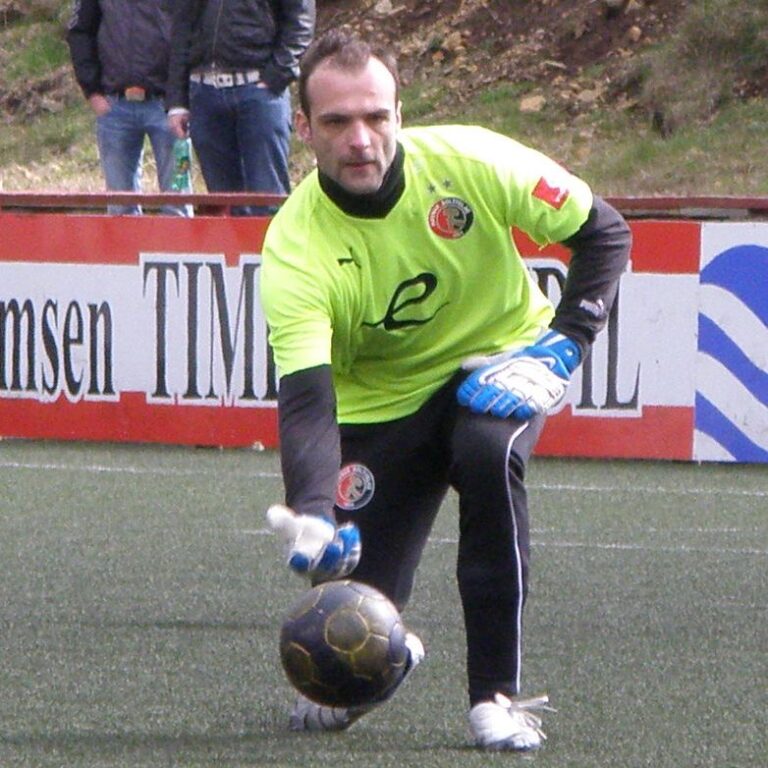



When Liverpool agreed a package worth up to £30m with Genk for an 18-year-old goalkeeper who will not walk through the doors at the AXA Training Centre until 2027, it was less a transfer than a statement of method. Lucca Brughmans — 6ft 7in, the Belgium youth international who captained his country to the semi-finals of the 2025 Under-17 European Championship — became the most expensive teenage goalkeeper in history without having played a minute of senior football in England. He signed a six-year contract and went straight back to Genk on loan.
Brughmans is the loudest example of a quiet, accelerating shift. Over the past 12 months Liverpool have signed Senegalese centre-back Mor Talla Ndiaye from Amitié FC in Dakar for around £1m, Austrian defender Ifeanyi Ndukwe for roughly £2.3m, Colombian attacking midfielder Samuel Martinez from Atlético Nacional for about £700,000 — beating Barcelona and Chelsea to his signature — and French striker Djylian N’Guessan from Saint-Étienne for £4.3m. Hungarian goalkeeper Armin Pécsi arrived from Puskás Akadémia for £1.2m and was nominated for the 2025 Golden Boy. Almost none of them are at Anfield right now. Ndukwe is at Levante, Pécsi at TSV Hartberg, N’Guessan at Brest. That is the point.
The department behind the shift
The architect is Matt Newberry, who has led Liverpool’s global talent department since the winter of 2024 and now reports into a recruitment structure overseen by sporting director Julian Ward. Where the club once scouted the world and bought at 21, Newberry’s remit is to identify and contract players at 16 and 17, park them in competitive environments abroad, and deliver them to Merseyside at the point of readiness.
Academy director Alex Inglethorpe, the constant through Liverpool’s youth production line for more than a decade, has been careful to frame the strategy as development rather than speculation. “Any player we sign, the first intention is that we want them to play in the first team,” he said. Under-21 manager Rob Page, speaking about Ndiaye’s journey from Dakar to Kirkby, offered a more grounded assessment: “He’s an incredible story. He’s nowhere near the finished article but he’s on the right path.”
Why the model had to change
Liverpool have generated more than £230m since 2020 from selling players who came through their youth system — a cornerstone of Fenway Sports Group’s self-sustaining model, and the reason Anfield has rarely needed to gamble in the transfer market. But that seam has been worked hard. Trent Alexander-Arnold, Jarell Quansah, Caoimhín Kelleher, Ben Doak, Tyler Morton, Curtis Jones, Stefan Bajčetić and Nat Phillips have all departed across recent windows. The pipeline that funded the club emptied faster than it refilled.
At the same time, the cost of buying finished players has become extraordinary. Liverpool have committed north of £100m apiece on Florian Wirtz, Alexander Isak and Bradley Barcola across two summers, taking their squad outlay towards £450m while banking comparatively little in sales. Elsewhere, Ayyoub Bouaddi’s £86m move made him the most expensive teenager in history. If a proven 22-year-old now costs nine figures and an unproven 18-year-old costs eight, the economics push clubs further and further down the age curve.
Brexit made this the only route
There is a regulatory driver too, and it is decisive. Since Brexit, Premier League clubs cannot register players under 18 from European countries. That single rule explains the deferred structure of nearly every deal Liverpool have done: Brughmans arrives for 2027-28, N’Guessan in January 2027, Martinez in the summer of 2027. Clubs are effectively buying options on adolescents and waiting two years to collect. The premium is the price of getting there first.
Inglethorpe has acknowledged as much. “Time will tell if that premium is worthwhile,” he said, “but it’s definitely a change.” It is also a change Liverpool do not always win. Arsenal beat them to Georgian defender Andria Bartishvili, 17, who joins the Emirates in 2027.
The risk, and the reward
The downside is not theoretical. Giovanni Leoni cost around £26m from Parma at 18 and tore his anterior cruciate ligament on his debut, in the Carabao Cup against Southampton, ruling him out for a year. Teenagers get injured, stall, or arrive into a first team with no room for them. Andoni Iraola, appointed in June to succeed Arne Slot, inherits a squad assembled at enormous cost and a cohort of prospects who will need minutes he may not be able to give.
The counterweight sits in his own dressing room. Rio Ngumoha, signed from Chelsea’s academy in 2024, and Trey Nyoni, recently tied to a new long-term deal, are the proof that the pathway still functions. What Liverpool are betting is that the next Ngumoha will not be found in Kirkby or Cobham, but in Dakar, Medellín or Genk — and that finding him two years early is cheaper than buying him two years late.

Sports journalist and editor at SportsPortal.net. Covers cricket, football, Formula 1, tennis, and basketball with a focus on how global sports connect with Pakistani audiences. Follows the PSL, Pakistan national cricket team, Premier League, and major international tournaments. Has reported on sports for digital audiences since 2021.
907 articles published