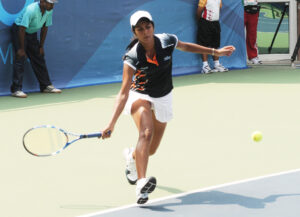


When Iga Swiatek walks onto Court Philippe-Chatrier on Thursday to face Aryna Sabalenka, the four-time Roland Garros champion will not shake her opponent’s hand. When Elina Svitolina meets Marta Kostyuk in the other semi-final earlier the same afternoon, both Ukrainians will embrace before facing a winner who, by Saturday, may be required to play Sabalenka — a Belarusian whose country remains the launchpad from which Russian forces continue to strike Kharkiv, Svitolina’s home city. Four years and three months into Russia’s full-scale invasion of Ukraine, the women’s draw at the 2026 French Open has produced a semi-final bracket the WTA Tour has spent the entire war trying to avoid.
The handshake that won’t happen
Svitolina, the world number 14 and a Roland Garros quarter-finalist in five of the last seven editions, has not shaken hands with a Russian or Belarusian player since February 2022. Kostyuk, ranked 19th and the more vocal of the two on tour, has gone further, refusing even eye contact in the pre-match coin toss at last year’s Madrid Open. Both have been booed for it — Kostyuk at Roland Garros in 2023, after declining to acknowledge Sabalenka following a 6-3, 6-2 first-round defeat. The French crowd, then unfamiliar with the protocol, jeered her off court. Kostyuk, 23, walked to her chair in tears and told reporters afterwards: “I don’t expect people who have never lived through what we live through to understand. I expect them to read.”
That reading has, slowly, been done. The WTA issued formal guidance in 2023 instructing umpires not to penalise Ukrainian players for declining the customary handshake, and tournament directors now brief crowds before matches featuring Ukrainian and Russian or Belarusian opponents. Roland Garros organisers confirmed on Tuesday that a multilingual announcement will be made before both Thursday semi-finals, asking spectators to respect the players’ choices. Sabalenka, who has previously called the situation “not my fault” and “not my war,” said in her post-quarter-final press conference: “I understand. I would do the same if it were my country. There is nothing to discuss at the net.”
A war that has shaped a generation of players
Svitolina, 31, gave birth to her daughter Skai in October 2022, eight months after the invasion began, and returned to the tour in April 2023 with a stated mission: to play, to win, and to direct prize money toward Ukrainian children displaced by the war. Her foundation has, by her own accounting, distributed more than €2.4 million since 2022, funding rehabilitation centres in Lviv and a sports programme for amputee children in Kyiv. She reached the Wimbledon semi-final that summer as a wildcard, a run that included a third-round win over Belarusian Victoria Azarenka and the same no-handshake protocol that will define Thursday.
Kostyuk’s path has been harder and louder. Her family home in a Kyiv suburb was damaged by shrapnel in March 2022. She has used post-match interviews to name specific Russian strikes — the Okhmatdyt children’s hospital attack in July 2024, the Sumy missile strike of April 2025 — and has repeatedly criticised the WTA for allowing Russian and Belarusian players to compete under neutral flags rather than face suspension. The Ukrainian Tennis Federation backed her in a January 2026 letter to the ITF that went unanswered. Both players have continued to compete against Russians and Belarusians under protest, distinguishing — as Svitolina put it last year — “between the sport, which we love, and the silence of the players, which we cannot forgive.”
What Saturday could look like
The bracket scenarios are stark. If Svitolina beats Kostyuk and Sabalenka beats Swiatek, the final will be the first Grand Slam decider between a Ukrainian and a Belarusian since the invasion began. If Kostyuk wins her semi-final and faces Sabalenka, the discomfort will be sharper still: Kostyuk has been the most explicit critic of any active Belarusian player who has not condemned the war by name. Sabalenka, the world number one and defending Australian Open champion, has navigated the question with deliberate vagueness, declining in 2023 to say whether she supports Alexander Lukashenko and offering, in 2024, only that she “wants peace.”
The prize on the line — the Coupe Suzanne Lenglen, €2.55 million, and a likely return to world number one for Swiatek if she wins — will, on Saturday, share the trophy presentation with something heavier. Roland Garros has staged finals during wars before; it last did so in 1939, and again, under occupation, in 1941. None of those finals featured a player whose country was being actively bombed by the opponent’s ally. This one might.
Whatever happens on Thursday, the handshake at the net will not.

Sports journalist and editor at SportsPortal.net. Covers cricket, football, Formula 1, tennis, and basketball with a focus on how global sports connect with Pakistani audiences. Follows the PSL, Pakistan national cricket team, Premier League, and major international tournaments. Has reported on sports for digital audiences since 2021.
1030 articles published