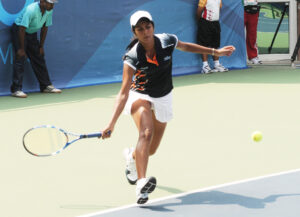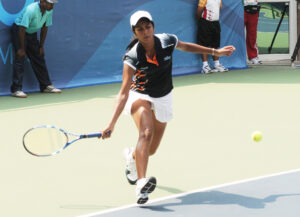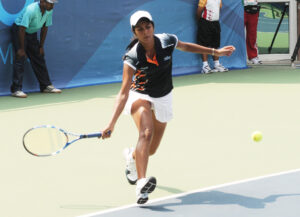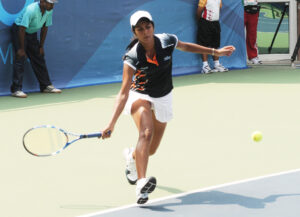




Maja Chwalinska traced the small ink mark on her left forearm before every changeover at Court Philippe-Chatrier on Thursday, a ritual that has carried the 24-year-old Pole from world No. 187 to within one match of the most improbable Grand Slam title in the Open era. Her 6-4, 3-6, 7-5 semi-final victory over Mirra Andreeva, the 19-year-old world No. 6, lasted two hours and 41 minutes and ended with Chwalinska sinking to the clay, kissing the tattoo, and weeping into her hands. She is the first qualifier to reach a French Open final since Mima Jausovec in 1983, and the lowest-ranked woman to play for the title at Roland Garros since rankings began in 1975.
The semicolon and what it carries
The tattoo is a semicolon, no larger than a fingernail, inked on the inside of her left wrist in November 2024. The semicolon is a symbol adopted by Project Semicolon, the mental health awareness movement founded in 2013 — a punctuation mark used when an author could have ended a sentence but chose to continue. Chwalinska has spoken openly this fortnight about the 14 months she spent away from the WTA Tour between September 2023 and November 2024, a period during which she was treated for clinical depression and an eating disorder that dropped her body weight to 47 kilograms.
“I was not sure I would play tennis again. I was not sure of a lot of things,” Chwalinska said after beating Andreeva. “The tattoo is a reminder. Every point I do not want to play, every point I am scared, I look at it. It says: keep going. The sentence does not end here.”
Her run to the final has been built on grinding three-set victories. She has played 18 sets across seven matches, including three qualifying rounds, winning 12 of them. Her first-round opponent, 14th seed Daria Kasatkina, took her to 9-7 in the third. She came back from 1-5 down in the deciding set against Beatriz Haddad Maia in the fourth round. Against Andreeva, she saved nine of 11 break points and won 71 per cent of points on her second serve in the third set — a figure Andreeva matched only twice across her own run to the semi-finals.
A draw that opened, a player who walked through
The bottom half of the women’s draw at Roland Garros collapsed early. Iga Swiatek, the four-time champion, was beaten in the third round by Linda Noskova. Aryna Sabalenka, the world No. 1, lost in the quarter-finals to Madison Keys. Coco Gauff withdrew before her fourth-round match with a hip injury. The path Chwalinska walked was real, but it was also unguarded — and she met every test that remained.
Her statistical profile this fortnight is unusual for a Roland Garros finalist. She averages 158 km/h on first serve, slower than every other woman who has reached the final since 2015. She has hit 89 winners across seven matches, fewer than half the total Andreeva alone produced in her quarter-final. What Chwalinska has done is move. According to Roland Garros tracking data, she has covered 41.2 kilometres across her seven matches — more ground than any other player in the women’s draw, men or women, by a margin of 4.8 kilometres.
What Saturday means
She faces world No. 2 Jasmine Paolini in the final on Saturday, a rematch of the 2024 third round in Paris that Paolini won 6-2, 6-1 in 54 minutes. Paolini, the reigning French Open finalist, has dropped just one set this fortnight and will start as a heavy favourite. Bookmakers in London on Thursday evening priced Chwalinska at 11/2 — the longest odds for any women’s Grand Slam finalist since Emma Raducanu won the 2021 US Open at 150/1.
What is already settled is the prize money. Chwalinska, who earned $48,000 in total prize money in 2024, has guaranteed herself €1.275 million by reaching the final. The runner-up cheque alone would lift her to a projected ranking of world No. 24 — the highest of her career by 163 places. A title would take her inside the top 15.
The wider significance is harder to price. Polish tennis has lived in Swiatek’s shadow for five years; Chwalinska is, at 24, two years older than her compatriot and was once ranked above her at junior level. Their paths diverged in 2019, when Swiatek made her senior breakthrough at Roland Garros and Chwalinska’s body began to fail her.
- Lowest-ranked Roland Garros women’s finalist in the Open era: Chwalinska, No. 187
- First qualifier in the French Open women’s final since Mima Jausovec, 1983
- Career prize money before this fortnight: $312,000 across seven seasons
- Polish women’s Grand Slam finalists in the Open era: Jadwiga Jedrzejowska (1939, pre-Open), Agnieszka Radwanska (Wimbledon 2012), Iga Swiatek (six finals), Chwalinska
“I am not thinking about Saturday yet,” she said. “I am thinking that I am here. That is already the thing I did not believe.”

Sports journalist and editor at SportsPortal.net. Covers cricket, football, Formula 1, tennis, and basketball with a focus on how global sports connect with Pakistani audiences. Follows the PSL, Pakistan national cricket team, Premier League, and major international tournaments. Has reported on sports for digital audiences since 2021.
1033 articles published