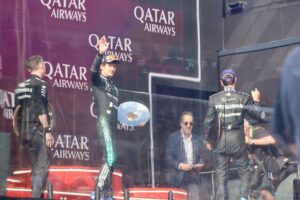


Four. That is how many on-track overtakes Formula 1 managed across 57 laps of the inaugural Spanish Grand Prix at Madrid’s new Madring — a circuit that cost a fortune, carries a contract to 2035 and was sold as the sport’s showpiece urban venue. Kimi Antonelli won his eighth race of the season, but almost nobody left the Ifema complex talking about him. They left talking about a racetrack that half the grid had already written off before the lights went out.
Lando Norris, who took pole and should have won, put it most bluntly: “I don’t know how someone looks at this design and goes: ‘Mint.'” Alex Albon called the race “pretty boring”. Gabriel Bortoleto said he “almost fell asleep”. Antonelli, the man holding the trophy, conceded the layout “definitely doesn’t create overtaking opportunities”.
How do you get a purpose-built track this wrong?
That is the question readers keep asking, and it is a fair one. Roughly half the 5.414km, 22-turn Madring is newly built rather than repurposed exhibition-centre road, so there was a blank sheet of paper available. Designer Jarno Zaffelli and Studio Dromo delivered plenty of spectacle — two tunnels beneath an elevated motorway, a steep downhill plunge between turns seven and nine, and La Monumental, the longest banked curve in F1, capped at 13.5 degrees to avoid the tyre failures that plagued Indianapolis.
What it does not have is a single proper overtaking zone. There is no long straight feeding into a heavy, square braking area. Instead, the corners that follow the quickest sections demand braking and steering at the same time, which kills the following car’s ability to commit. The walls sit uncomfortably close on several exits, so drivers will not risk the wide line that a pass requires. And the pit lane — the longest on the calendar — makes a second stop prohibitively expensive, stripping out strategic variety.
The result is a circuit that is genuinely thrilling over one lap and inert over a race distance. George Russell’s 1:35.587 lap record was set on a layout drivers enjoy on Saturday and endure on Sunday. Norris summed up the split perfectly: great in qualifying, “not a great racetrack”.
The race that exposed it
Madrid’s problem was compounded by the way the win was decided. Norris led comfortably until a virtual safety car, triggered by Lance Stroll’s brake failure, handed Mercedes a free pit window. Antonelli and Max Verstappen stopped immediately; Norris’s own stop, once he got there, took seven seconds and dropped him to fifth behind Charles Leclerc, who had not pitted at all. Leclerc then led for roughly 28 laps before stopping on lap 48, gifting Antonelli a lead he never surrendered.
On a normal circuit, Norris recovers. At the Madring, he could only claw back to third, 5.089s behind a winner who admitted the result was not earned. “It’s good to win,” Antonelli said, “but it doesn’t feel as good because I think Lando today deserved to win.”
That is the real indictment. A track’s quality is measured by whether a fast car in clean air can still be caught. Here, a bad pit stop was a life sentence. The VSC quirk — losing the lead purely because of where you were relative to the pit entry — is a rules issue that has been raised in driver briefings before, but it only became decisive because the racing itself offered no route back.
What changes for 2027
Encouragingly, the organisers are not digging in. Madring managing director Luis Garcia Abad has told both F1 and the FIA that the venue is prepared to alter the layout before it is reinstalled next year — an advantage of a part-temporary circuit that a permanent venue simply does not have. Toto Wolff says the promoters “are totally open-minded about next year”; Ferrari’s Frederic Vasseur says they “are keen to do modifications in the future”.
The fixes being discussed are specific rather than cosmetic:
- Delete turns 18 and 19 to create a long straight into a hairpin — Norris’s own suggestion
- Widen the entry to that braking zone, along the lines of Austin’s Turn One
- Rework the Turn Five chicane and the turns five-to-seven sequence
- Revisit the pit-lane loss to make a two-stop viable
Madrid has the infrastructure right — 110,000 capacity, the first covered paddock in F1 history, a city-centre location and expansion plans towards 140,000. Barcelona was dropped partly because it could not deliver that. But a ten-year contract signed on the promise of great racing has opened with one of the most processional Sundays of 2026. The fix is available, it is affordable, and it needs to arrive before the second race, not the fifth.

Sports journalist and editor at SportsPortal.net. Covers cricket, football, Formula 1, tennis, and basketball with a focus on how global sports connect with Pakistani audiences. Follows the PSL, Pakistan national cricket team, Premier League, and major international tournaments. Has reported on sports for digital audiences since 2021.
818 articles published