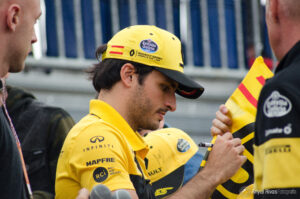

Max Verstappen’s car was the first to die on a sodden Sepang formation lap. Ninety minutes later, after an FIA software patch had been written, validated and uploaded to all eleven teams, he was back on the grid — and by the end of the afternoon he had converted the most chaotic Sunday of the 2026 season into his 72nd grand prix win, the first for Red Bull’s in-house powertrain and his first victory since the 2025 Abu Dhabi finale.
BBC Radio 5 Live Formula 1 commentator Harry Benjamin rates the drivers from the Formula 1 Gulf Air Bahrain Grand Prix in Malaysia — a race that produced eight or nine stricken cars across seven teams, a red-flagged start, a full grid reset, and a podium nobody would have predicted when the field crawled to a halt.
Verstappen’s near-flawless afternoon tops the ratings
Verstappen takes the highest mark of the weekend, and it is not especially close. He had pole, lost it almost immediately — swamped by Kimi Antonelli and George Russell off the line at the restart — and then rebuilt the race from third on the road with the kind of patient tyre management that defined his title-winning years. On a track surface that went from standing water to greasy to dry, he made no errors at all.
He was also the most measured voice afterwards, diagnosing the failure with more precision than most engineers managed in real time. “These engines are so complicated and a lot of software is implemented,” Verstappen said. “When you go too low in speed and too low RPM, for whatever reason, then it just bogs down.”
Antonelli earns the second-best rating. The Mercedes driver out-dragged a Red Bull on the restart, led in the early wet phase and extended his drivers’ championship lead to 84 points — a buffer that now looks close to decisive with the season entering its closing stretch. He has done it in his breakthrough campaign, under the sort of pressure that has broken more experienced title contenders.
Hamilton’s recovery drive and the midfield marks
Lewis Hamilton’s rating is the most generous relative to his finishing position, and deservedly so. His Ferrari rolled to a stop on the formation lap — the second car to go — and the seven-time champion was, by his own account, close to being out of the race before it began. “It was like the LEGO race,” Hamilton said afterwards, a line that will outlive most of the technical explanations.
From that start he brought the car home third, ahead of team-mate Charles Leclerc in fourth, a reversal of the intra-Ferrari order that had held for most of the weekend. In a season where Hamilton’s Maranello adaptation has been scrutinised relentlessly, it was his most convincing wet-weather drive in red.
The remaining marks follow a clear logic — reward drivers who kept the car pointing forwards on a day when simply finishing was an achievement:
- Isack Hadjar — fifth, and the standout result outside the big three teams. No mistakes, no complaints.
- Oscar Piastri — sixth for McLaren, solid rather than spectacular, and notably restrained in his post-race assessment: he had “never seen an F1 race delayed by a bug” but urged patience before judgement.
- Liam Lawson — seventh for Racing Bulls, having been one of the cars that stopped on the formation lap alongside Gabriel Bortoleto and Valtteri Bottas.
- Fernando Alonso — eighth for Aston Martin, extracting a points finish from a car that had no business scoring.
- Lando Norris — ninth, and a weekend he will want to forget. He called the event “horrible” and blamed the complexity of the new power unit design.
- George Russell — the lowest mark among the frontrunners. He led early, then stopped behind the late safety car, a result that effectively ends his realistic title challenge.
What the ratings say about the title run-in
The significance runs deeper than one scorecard. This was Formula 1’s first wet event under the 2026 regulations, which is precisely why the 250kW low-grip electrical torque cap had never been activated — not in testing, not in a race. FIA single-seater director Nikolas Tombazis conceded the point: “We didn’t manage to test the software as extensively as we would have liked because there has been very little wet running this year.”
That matters for how these ratings should be read. Driver performance was partly a function of how quickly each one adapted to a car that had changed behaviour mid-session. Verstappen and Hamilton, the two most experienced men on the grid, handled it best — and that is not a coincidence.
Going forward, Antonelli’s 84-point cushion is the headline number, but Verstappen’s win changes the texture of the championship. Red Bull now has a powertrain that can deliver victories, Ferrari has a wet-weather reference point, and the FIA has a full review to conduct before the next time it rains.

Sports journalist and editor at SportsPortal.net. Covers cricket, football, Formula 1, tennis, and basketball with a focus on how global sports connect with Pakistani audiences. Follows the PSL, Pakistan national cricket team, Premier League, and major international tournaments. Has reported on sports for digital audiences since 2021.
950 articles published