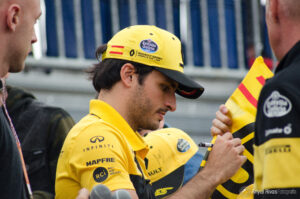




Valtteri Bottas will arrive at the Singapore Grand Prix the way almost no Formula 1 driver ever has: sweating, on two wheels, having pedalled across an international border.
The Cadillac driver has opted to make the journey south from Malaysia to Marina Bay by bicycle — a ride of roughly 350km down the Malay Peninsula, over the Johor–Singapore Causeway and into the city that hosts the most physically punishing race on the calendar. It is the sort of pre-race preparation that would make most team physios reach for the phone, and the sort of thing that surprises nobody who has followed Bottas’s second life as a serious endurance athlete.
The 37-year-old Finn, a 10-time grand prix winner with 20 pole positions and 67 podiums across spells at Williams, Mercedes and Sauber, spent 2025 out of a race seat as Mercedes’ reserve driver before Cadillac handed him a return to the grid for the American team’s debut season alongside Sergio Pérez.
The cyclist who happens to drive F1 cars
Bottas’s commitment to cycling is not a publicity exercise bolted on to a race weekend. He has built a genuine second identity in gravel racing, competing in open amateur fields where there is no garage, no engineer and no sporting director to smooth the way — just a start list and a result.
He co-founded FNLD GRVL, a gravel event based in Lahti, Finland, and has become one of the sport’s most visible crossover figures, racing against riders who have no particular interest in who finished where at Monza. His off-season training blocks have long been built around the bike rather than the gym, and his charity calendar project has funnelled the attention his cycling generates into fundraising.
What separates this from the usual driver-fitness story is the context. Formula 1 personnel move between races on charter flights and in air-conditioned convoys; the travel is treated as recovery time, not training load. Choosing to cover a multi-hundred-kilometre transfer under his own power, in equatorial heat and humidity, inverts the normal logic of a race week entirely.
Why Marina Bay makes it a gamble
Singapore is the race where drivers least need extra fatigue. The Marina Bay Street Circuit is a night race run in daytime-equivalent conditions, with track temperatures and humidity that routinely push cockpit temperatures above 50C. The specifics explain why the paddock treats it with respect:
- Drivers can lose up to 3kg in body fluid over a single grand prix distance
- Cooling vests and medically approved driver-cooling systems have been introduced in response to heat-related incidents at the race
- The lap is a slow, walled, low-visibility street layout with almost no rest sections and a consistently high steering load
- Safety cars are near-inevitable, extending race duration towards the two-hour limit
Arriving with accumulated fatigue in your legs and a dehydration deficit to repay is, on paper, a poor trade. The counter-argument is the one endurance athletes make: heat adaptation is trainable, and deliberate exposure to heat and humidity in the days before competition is a recognised method rather than a reckless one. A rider who has spent hours acclimatising in Malaysian conditions may walk into the Marina Bay paddock better prepared for it than a driver who stepped off a flight the day before.
The risk sits in the margins — a crash, a mechanical, a stomach bug from roadside food, a border queue in 34C heat. Those are real, and they are the reason this remains an outlier rather than a trend.
What it means for Bottas and Cadillac
For Cadillac, a first-year team still building credibility in the paddock, a driver who generates this kind of story without manufacturing it is an asset. New entrants struggle for attention that is not about lap deficits; Bottas’s cycling gives the team a narrative that has nothing to do with where it sits in the constructors’ standings.
For Bottas himself, it fits a pattern established since he left the front of the grid. Freed from the relentless scrutiny of a Mercedes seat, he has leaned into the parts of his sporting life that are his own — the gravel racing, the Finnish events, the refusal to treat Formula 1 as the only thing worth being good at.
There is also a harder edge to it. At 37, in a season where Cadillac’s competitiveness will be judged against expectations deliberately set low, Bottas is demonstrating that his physical preparation has not slackened. Drivers returning from a year on the sidelines are routinely questioned about sharpness and conditioning. Pedalling to a grand prix is an emphatic way of closing that line of questioning.
Whether it helps him on Sunday night is unknowable. Whether it tells you something about the driver is not.

Sports journalist and editor at SportsPortal.net. Covers cricket, football, Formula 1, tennis, and basketball with a focus on how global sports connect with Pakistani audiences. Follows the PSL, Pakistan national cricket team, Premier League, and major international tournaments. Has reported on sports for digital audiences since 2021.
950 articles published