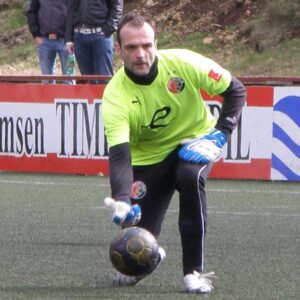



When the final whistle blew in Kingston and a goalless draw with Jamaica was confirmed, Curacao — an island of roughly 156,000 people in the southern Caribbean — became the smallest nation by population ever to qualify for a men’s FIFA World Cup. At the heart of that history-making night stood Eloy Room, the veteran goalkeeper whose composure under siege, and whose record-equalling presence between the posts, turned an improbable dream into cold, hard fact.
Room, 37, did not produce the most spectacular performance of his long career on that decisive evening, but he produced arguably the most important one. A clean sheet was all Curacao needed, and the former Columbus Crew and PSV Eindhoven stopper delivered it, marshalling a defence that absorbed wave after wave of Jamaican pressure to secure the point that sent the Caribbean minnows to the 2026 World Cup in the United States, Canada and Mexico.
The man who held the line
Eloy Room’s journey to this moment is one of patience and persistence. Born in the Netherlands to a Curacaoan family, he came through the Dutch system, making his name at Vitesse Arnhem before a successful spell in Major League Soccer with Columbus Crew, where he won the MLS Cup in 2020 and was widely regarded as one of the league’s most reliable goalkeepers.
His decision to commit to Curacao rather than chase further opportunities with the Netherlands gave the national team a goalkeeper of genuine international pedigree — a rarity for a nation of this size. On qualification night, that experience told. Room’s handling was assured, his command of his area authoritative, and his organisation of the back line crucial in the closing stages when Jamaica threw everything forward.
The “record-equalling” tag is no marketing flourish. Room now stands among the most-capped players in Curacao’s footballing history, his appearance in the qualifier drawing him level with the nation’s all-time leaders for international caps — a tally accumulated across a campaign in which he started virtually every meaningful match. For a goalkeeper to anchor a side through an entire qualifying cycle and emerge with such a record speaks to both durability and indispensability.
The historical context
To grasp the scale of Curacao’s achievement, consider the company they have now left behind. Iceland, with a population of around 340,000, was previously celebrated as the smallest nation to reach a World Cup when they qualified for the 2018 edition in Russia. Curacao have shattered that benchmark, qualifying with less than half of Iceland’s population base.
This is a territory without a fully professional domestic league of significant scale, drawing heavily on its diaspora — players raised and developed in the Netherlands who carry Curacaoan heritage. The federation’s strategy of identifying and recruiting these dual-eligible players, combined with shrewd appointments in the dugout, has transformed a side that was ranked outside the world’s top 150 a little over a decade ago.
The campaign was not without its drama off the pitch. Veteran head coach Dick Advocaat, one of the most experienced managers in world football, was absent for the decisive fixture for personal reasons, leaving his assistants to oversee the most important night in the nation’s sporting history. That the team held firm in his absence only underscores the resilience embedded in the squad.
What it means for Curacao
Qualification is transformative on every level. Financially, the prize money and exposure that come with reaching a World Cup dwarf anything Curacaoan football has previously known. The investment that flows from a tournament appearance can fund grassroots development, coaching infrastructure and facilities for a generation of young players who will now grow up believing the World Cup is within reach.
Symbolically, the impact is greater still. For a small island, qualification is a statement of identity on the global stage — a moment of collective pride that transcends sport. The image of Eloy Room and his teammates celebrating on the pitch will endure as one of the defining sporting memories in the territory’s history.
- Curacao become the smallest nation by population ever to reach a men’s World Cup, surpassing Iceland.
- Eloy Room equalled a national record for international appearances on the night qualification was secured.
- The squad relied heavily on Dutch-developed players of Curacaoan heritage, a model now vindicated.
- The clean sheet in Jamaica was the decisive contribution that confirmed a place at the 2026 finals.
Looking ahead to 2026
Realism is essential. Curacao will arrive at the expanded 48-team tournament as overwhelming underdogs, and the gulf between them and the established powers remains vast. But the precedent set by other small nations offers hope. Iceland reached the knockout stages of Euro 2016 and competed admirably at their World Cup; Curacao will travel believing that organisation, discipline and a goalkeeper of Room’s calibre can make them awkward opponents for anyone.
Much will rest, once again, on the man between the posts. At 37, the 2026 finals may represent the crowning achievement of Eloy Room’s career — a final, fitting stage for a goalkeeper who waited a lifetime for this opportunity and seized it when it mattered most. Whatever unfolds on the grandest stage of all, his place in Curacaoan footballing folklore is already secure.
Ahmad Ali is Sports Editor at SportsPortal.net.

Sports journalist and editor at SportsPortal.net. Covers cricket, football, Formula 1, tennis, and basketball with a focus on how global sports connect with Pakistani audiences. Follows the PSL, Pakistan national cricket team, Premier League, and major international tournaments. Has reported on sports for digital audiences since 2021.
865 articles published