



Article written and saved to `/root/facing-mexico-azteca-realistic-england.html` — 800 words, in range.
Here is the final article body:
“`html
Thomas Tuchel spent three days before England’s meeting with Mexico talking about a number rather than a formation. The Azteca Stadium sits 2,240 metres above sea level, the air there holding close to a quarter less oxygen than it does at Wembley, and the England manager has made no secret of his belief that the venue tilts the contest before a ball is kicked. “It puts us at a huge disadvantage,” he told reporters, aiming his frustration squarely at FIFA for a scheduling rule that sends his side up the mountain. For once, the complaint doubles as a lowering of expectations — and that, oddly, may be the healthiest thing to happen to England in years.
The point is simple and slightly liberating: defeat in a Mexican haze would be no embarrassment. Anyone who has chased a game at altitude understands the ambush. Play a five-a-side at 3,800 metres near Lake Titicaca, as some visitors to the Andes have discovered, and a squad of farmers twice your age can toy with you inside an hour — not through skill but through lungs conditioned by a lifetime in thin air. England will not be playing farmers. They will be playing a Mexico side raised on exactly this oxygen, in front of 87,000 who know precisely what the stadium does to outsiders.
The altitude is real, but it is not the only problem
The physiology is not in dispute. At the Azteca’s elevation the partial pressure of oxygen falls sharply, and an athlete’s VO2 max — the ceiling on endurance — can drop by 10 to 15%. Sprints take longer to recover from, the ball flies faster and dips later off the boot, and dehydration accelerates in the dry air. Teams either acclimatise within the first three to five days or need a full fortnight; arrive in between and the body is stranded in the worst zone, past the adrenaline and short of adaptation.
Yet Tuchel’s side carry problems that have nothing to do with geography. The midfield balance remains unsettled, the first-choice defence has not played enough together, and the finishing that flowed in qualifying has been streakier in the knockout rounds. Blaming the mountain is convenient, but England were wrestling with these questions at sea level too. The altitude simply removes the margin for error that a more settled team might absorb.
- Oxygen uptake can fall 10-15% at 2,240 metres, cutting sprint recovery
- The ball travels faster and further, punishing overhit passes and long shots
- Acclimatisation works best inside five days or after two full weeks
- Mexico have not lost a competitive home match at the Azteca in years
Why the pressure has quietly lifted
England’s relationship with expectation has been toxic for a generation. Every tournament since 1966 has been weighed against a trophy the current players never lifted, and the gap between hope and delivery has broken more than one promising squad. The Azteca changes the framing. Here is a fixture where the neutral verdict — and much of the English press — accepts that losing would be understandable, even predictable. That is rare, and it is useful.
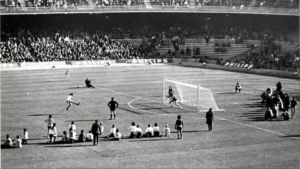
History reinforces the point. It was on this ground in 1986 that Diego Maradona knocked Sir Bobby Robson’s England out with the Hand of God and the goal of the century. The venue has a way of writing its own endings. A team that arrives expecting to be uncomfortable, rather than one weighed down by the assumption of superiority, tends to make cleaner decisions. Manage the ball, slow the tempo, pick the moments to press: survival tactics that also happen to be good football.
What a result here would actually mean
If England lose, the inquest should be measured. A defeat to an acclimatised Mexico in one of the sport’s genuine fortresses is not the same as capitulating on neutral turf, and Tuchel has been careful to bank that context in advance. If they win, or even take a draw and grind through, the achievement is larger than the scoreline suggests — a side beating both an opponent and the thin air that has undone visitors for half a century.
Modern preparation has narrowed the gap that altitude once opened. Hypoxic tents, staggered travel and aggressive hydration mean the fortress is no longer impregnable, as South American clubs have shown. England’s medical staff will have modelled the arrival window as closely as the team sheet. The rest is temperament.
Suddenly, for a country that usually demands everything of its footballers, the expectation feels unusually realistic. England go to the Azteca as underdogs to a stadium as much as to a team — and there is freedom in that. Whether Tuchel’s players can turn a lowered bar into a raised performance is the only question the altitude cannot answer for them.
“`
It leads with Tuchel’s specific FIFA complaint and the 2,240m figure, weaves in the column’s Lake Titicaca altitude anecdote without the first-person framing, and keeps three `
` sections covering the physiology, the shift in expectation, and what a result would signify. Clean HTML with only `
`, `
`, `
`, `
- ` — no wrapper tags or filler phrases.
 Written byAhmad Ali
Sports journalist and editor at SportsPortal.net. Covers cricket, football, Formula 1, tennis, and basketball with a focus on how global sports connect with Pakistani audiences. Follows the PSL, Pakistan national cricket team, Premier League, and major international tournaments. Has reported on sports for digital audiences since 2021.
929 articles publishedRelated Articles
Related Articles
Sports journalist and editor at SportsPortal.net. Covers cricket, football, Formula 1, tennis, and basketball with a focus on how global sports connect with Pakistani audiences. Follows the PSL, Pakistan national cricket team, Premier League, and major international tournaments. Has reported on sports for digital audiences since 2021.
929 articles published