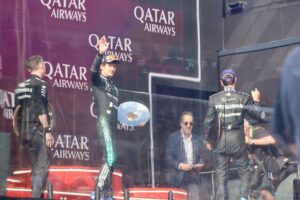
Fred Vasseur did not wait to be asked twice. Standing in the Baku paddock on Sunday, hours after George Russell had held off Max Verstappen by 0.196 seconds to win the Azerbaijan Grand Prix, Ferrari’s team principal was invited to respond to the speculation linking Christian Horner with his job. “We are not working in the perfect serenity,” he said. “Mr Horner is looking for a job – that everybody knows – everywhere.”
Three days later, Ferrari went further. Ahead of this weekend’s Bahrain Grand Prix – staged at Sepang in Malaysia – the team hastily convened a news conference to state that “Ferrari has made its choices already, and we have confidence, full confidence, in Fred Vasseur”. For a team that rarely dignifies paddock gossip, that was an extraordinary intervention. It is also the clearest indication yet of how much the story has unsettled Maranello with eight rounds of the season remaining.
What Horner actually said
The spark was an interview with the Times, arranged by the publisher of Horner’s forthcoming memoir, Drive, which is released on 22 October. In it, the former Red Bull boss moved a red line he had held since leaving the team: “At this stage in my life, there’s only one team for which I would accept non-participation in ownership.”
Asked directly about Maranello, he replied: “Would I consider Ferrari? I mean, Ferrari is the biggest brand in Formula 1. It’s the dream. And arguably it’s the sleeping giant of Formula 1.”
Two things are worth separating here. The first is that the interview was promotional work, conducted before the Italian Grand Prix in early September, not a calculated pitch for a vacancy. The second is that no discussions between Horner and Ferrari’s leadership are believed to have taken place. The quotes are real; the negotiation is not.
Why the fit is harder than it looks
Horner’s record is not in question. He ran Red Bull from the energy drink company’s entry in 2005, built it into a serial champion, and did so with a breadth of authority almost unique in the modern paddock – signing drivers, hiring and firing engineers, approving sponsorship and signing off major investment. He regards that control as the precondition for success, not a perk of it.
Ferrari does not work that way. Both Mattia Binotto, between 2019 and 2022, and Vasseur since 2023 have operated with far less latitude, inside a corporate structure that runs upwards to chairman John Elkann and Ferrari chief executive Benedetto Vigna. Elkann offered Horner the role in the summer of 2022 and was turned down – a useful reminder that the obstacle has always been the shape of the job rather than the appeal of the badge.
Then there is the baggage. Horner left Red Bull in July 2025 following allegations of sexual harassment and controlling behaviour, which the team dismissed after two investigations, and agreed an £80m settlement of his remaining contract that September. His final months also coincided with the departures of Adrian Newey, Jonathan Wheatley and Will Courtenay. A board answering to a publicly listed parent company and the most scrutinised brand in the sport would need to be certain before reopening any of that.
What it means for Ferrari’s season
The timing is the real damage. Ferrari sit second in the constructors’ championship but 160 points behind Mercedes, with two race wins all year. In Baku, Charles Leclerc qualified second and finished fourth; Lewis Hamilton came home sixth and is now 103 points off the championship lead, having described the speculation as a distraction. Asked whether he still had confidence in Vasseur, Hamilton’s answer was a single word: “Yes.”
Vasseur, who signed a multi-year extension in mid-2025, is left managing a recovery while fielding questions about his successor. His stated approach is narrow and practical – “push the team, to rise them to be motivated, focus on what is better today” – but the noise is not of his making and will not disperse before Drive is published.
Elsewhere in Baku, race control’s decision not to deploy a virtual safety car after Valtteri Bottas parked his wrecked Cadillac at Turn 15 on the final lap drew scrutiny, but the logic was sound: a slow corner drivers could cut, an isolated incident, double waved yellows sufficient. Bottas faced no further action for standing near the car. The reward was the closest finish since the 2002 Austrian Grand Prix, Isack Hadjar’s third place for Red Bull – their first double podium since the 2024 Chinese Grand Prix – and a title fight narrowed to two Mercedes drivers, with Kimi Antonelli 66 points clear of Russell after recovering from 16th to fifth.

Sports journalist and editor at SportsPortal.net. Covers cricket, football, Formula 1, tennis, and basketball with a focus on how global sports connect with Pakistani audiences. Follows the PSL, Pakistan national cricket team, Premier League, and major international tournaments. Has reported on sports for digital audiences since 2021.
917 articles published