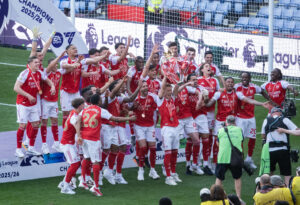

Josh Kroenke has lifted the lid on one of football’s most curious managerial inheritances, claiming the eerie silence of Covid-era stadiums gave Mikel Arteta the cover he needed to dismantle and rebuild Arsenal from the inside out. Speaking publicly about the Spaniard’s appointment in December 2019 for the first time in detail, the Arsenal co-chair argued that the absence of 60,000 supporters at the Emirates Stadium between March 2020 and the summer of 2021 was, paradoxically, the single most important factor in turning a “sleeping giant” into a club now competing for the Premier League title and challenging deep in the Champions League.
“The pandemic gave Mikel space,” Kroenke said. “Space to coach, space to teach, space to make hard decisions without a verdict being passed every Saturday at three o’clock. Reviving a sleeping giant is not something you do in front of a roaring crowd. He needed quiet, and football gave him quiet at exactly the right moment.”
The hard reset behind closed doors
The numbers behind Arteta’s first 18 months tell the story Kroenke is referencing. Arsenal finished eighth in 2019-20 and eighth again in 2020-21 — their two lowest league finishes since 1995 — yet that same period produced an FA Cup triumph against Chelsea in August 2020 and the quiet exits of Mesut Ozil, Sokratis Papastathopoulos, Shkodran Mustafi and Sead Kolasinac. None of those decisions would have been straightforward in a stadium full of paying customers demanding instant results.
Arteta inherited a squad with an average age of 27.4 and a wage bill north of £230m. By the start of 2022-23, the average age had dropped to 24.7, the youngest in the Premier League, and the club had spent more than £250m reshaping the spine of the side around Gabriel Magalhaes, Ben White, Martin Odegaard and Bukayo Saka. The 8-0 home defeat that Manchester City inflicted on the same Arsenal blueprint in August 2021 was watched by an Emirates crowd allowed back at full capacity only weeks earlier — a reminder, Kroenke suggested, of what the manager had been spared during the worst of the rebuild.
- Arsenal won the FA Cup in August 2020 in front of an empty Wembley, Arteta’s first major trophy as a head coach.
- The club’s net spend between summer 2020 and summer 2022 was £236m, the third-highest in Europe.
- Arsenal led the Premier League for 248 days in 2022-23 before finishing second to Manchester City.
- The Emirates has sold out every league fixture since fans returned in August 2021 — a run now stretching beyond 90 matches.
A Kroenke verdict that contradicts the script
The admission is striking because it cuts against the grain of how the Kroenke family’s stewardship of Arsenal has been portrayed. Stan Kroenke’s takeover was met with protests as recently as April 2021, when the abortive Super League project triggered marches outside the Emirates and chants of “Kroenke Out” carried into north London side streets. Josh Kroenke fronted a fan forum days later and committed to investment; the £150m signings of Declan Rice and Kai Havertz in 2023 were the visible follow-through.
Yet his framing of Covid as an enabler is more revealing than any transfer outlay. It acknowledges, implicitly, that Arsenal’s recruitment under Raul Sanllehi had failed, that the dressing room Arteta walked into was fractured, and that the cultural overhaul — the famous “non-negotiables” he hung on the training-ground walls at London Colney — would have been impossible to enforce with social-media clips of every training-ground row going viral by lunchtime. “There were moments,” Kroenke said, “when we knew the table didn’t reflect the work. Most ownership groups don’t get to see that. We got to see it because nobody else was in the building.”
What it means for the next chapter
Arteta is now contracted at Arsenal until June 2027 and has overseen back-to-back second-place finishes behind Manchester City, the first time the club has finished in the top two in consecutive seasons since 2004-05. The squad’s average market value, according to Transfermarkt, has risen from £429m in December 2019 to £1.07bn in May 2026, the second-highest in the Premier League.
The challenge Kroenke’s words frame is whether the next phase — winning the league for the first time since 2003-04 and progressing beyond a Champions League semi-final for the first time since 2009 — can be navigated with the noise back at full volume. The space Arteta was afforded by empty stands is gone. Every team-sheet, every substitution, every dropped point now plays out in front of a sold-out Emirates and a fanbase that has waited 22 years for a title. Kroenke’s argument is that the foundations laid in silence are strong enough to hold. The next 12 months will test it.

Sports journalist and editor at SportsPortal.net. Covers cricket, football, Formula 1, tennis, and basketball with a focus on how global sports connect with Pakistani audiences. Follows the PSL, Pakistan national cricket team, Premier League, and major international tournaments. Has reported on sports for digital audiences since 2021.
992 articles published