



Daniil Medvedev once explained what it would take to genuinely anger him away from a tennis court: someone would have to knock on his hotel door at 6am, seven days in a row. Off court he is dry, self-aware, almost unbothered. On court, the ledger reads differently — and on Sunday in Beijing it ran out of credit.
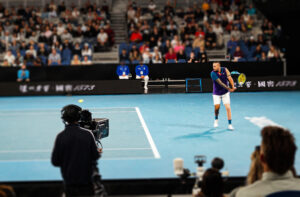
Medvedev was defaulted from the China Open semi-final against Novak Djokovic after swiping a backhand at a ball rebounding off the advertising boards and sending it into the front row, where it struck a male spectator near the left eye. The man was helped out of the arena and taken to hospital. Chair umpire Mohamed Lahyani came down from his seat with the tournament supervisor and applied the ball-abuse default provision. Djokovic was serving for the match at 7-5, 5-3, 15-15, two hours and 24 minutes in.
A swipe that cost points, prize money and a match he was losing
The tennis itself had already slipped away. Djokovic saved 16 of the 18 break points Medvedev created, the sort of statistic that explains an entire match: the Russian built pressure for two hours and converted almost none of it. Then came the ball off the boards, the loose flick of the wrist, and the end.
Medvedev did not argue. He shook hands with Djokovic at the net and accepted the ruling, forfeiting all ranking points and prize money from the tournament. His defence was consistent and, on the evidence, reasonable.
“It was 100 per cent accident,” he said. “You can see I didn’t hit the ball in anger. I do a lot of bad things but usually ball abuse is not my thing.”
That last clause is the story. Medvedev was not claiming innocence of temperament — he was claiming innocence of this specific offence, which is a very different plea. His remorse appeared genuine: “I feel terribly sorry for him actually and I just hope he’s OK.” And later: “When I saw the result, I felt horrible. Terribly sorry to the spectator, first of all. I’m trying to get in touch with him, if he wants it. I just really care about him right now. Hopefully I can meet him and make up for it somehow.”
The record that made this feel inevitable
Intent is not the test. The default rule exists precisely because a ball struck carelessly into a crowd produces the same hospital visit as one struck in rage. And Medvedev has spent two years accumulating the kind of conduct record that leaves officials with no appetite for leniency.
- 2025 Australian Open: fined roughly £54,000 for breaking a net camera.
- 2025 US Open: fined more than £30,000 after an incident involving a photographer.
- 2026 Monte Carlo: smashed his racket during a 6-0, 6-0 defeat.
Each was individually survivable. Collectively they describe a player who has been operating at the edge of the rulebook for long enough that the edge eventually found him. Medvedev’s own phrasing — “I do a lot of bad things” — is the admission that the Beijing default was an accident waiting for a host.
Djokovic, of all people, understood. “It is a bit of a shock, to be honest,” he said. “I also feel sorry for Daniil as I know exactly how it feels.” He does: at the 2020 US Open he was defaulted after striking a line judge in the throat with a ball hit away in frustration. That disqualification cost him a likely 18th major and followed him for years. It also, crucially, became a hinge point rather than a verdict — Djokovic won four of the next seven Grand Slams.
What it means for a career already drifting
Djokovic advanced to face ninth-ranked Alex de Minaur in Monday’s final, extending his China Open record to 33-0 at a tournament he has won six times between 2009 and 2015. It is his first event since losing the Australian Open final in January, and he is one win from a first title of 2026. For a 2026 Djokovic campaign defined by near-misses, the irony of reaching a final via a default is not lost on anyone.
Medvedev’s position is harder. The Monte Carlo double-bagel, the mounting fines and now a disqualification form a trajectory, not a run of bad luck. He will face an ATP review and almost certainly a further sanction on top of the forfeited points and money.
The fix is not a new forehand. Djokovic’s 2020 recovery came from treating the default as a floor rather than a footnote. Medvedev, calm enough to withstand seven mornings of 6am knocking, now has to prove he can withstand a ball bouncing back at him on break point. That has always been the harder test.

Sports journalist and editor at SportsPortal.net. Covers cricket, football, Formula 1, tennis, and basketball with a focus on how global sports connect with Pakistani audiences. Follows the PSL, Pakistan national cricket team, Premier League, and major international tournaments. Has reported on sports for digital audiences since 2021.
956 articles published